
Subscription-aware attribution
How Ordinary recognises subscription orders from any Shopify subscription app so recurring renewals don't inflate your attribution and acquisition numbers.
 Written by The Ordinary Team · Updated
On this page
Recurring reorders are left out of attribution on every plan. The Subscription Orders panel is available on Starter and higher.
If you sell subscriptions, your orders fall into three categories that need different attribution handling:
- One-off orders — customer bought without subscribing.
- First subscription order — customer’s initial subscription purchase. Pixel-tracked like a normal order.
- Recurring subscription reorder — your subscription app auto-bills the customer; no storefront click, no pixel session.
Lumping all three together distorts every attribution number. Ordinary splits them out.
How we detect subscription orders
Subscription apps that work through Shopify’s subscription system — Recharge, Shopify Subscriptions, Loop, Skio, Smartrr, Ordergroove and others — attach a selling plan to each subscribed line item. Ordinary reads that, so subscription lines are recognised whichever app you use, and in a mixed cart only the subscribed line counts as a subscription.
To tell a first subscription order from a renewal:
- Recharge tags —
Subscription First OrderandSubscription Recurring Orderare read directly when present. - Customer history — otherwise, a customer’s earlier subscription orders decide it.
What shows up where
Funnel (Brand Pulse → Store Conversion)
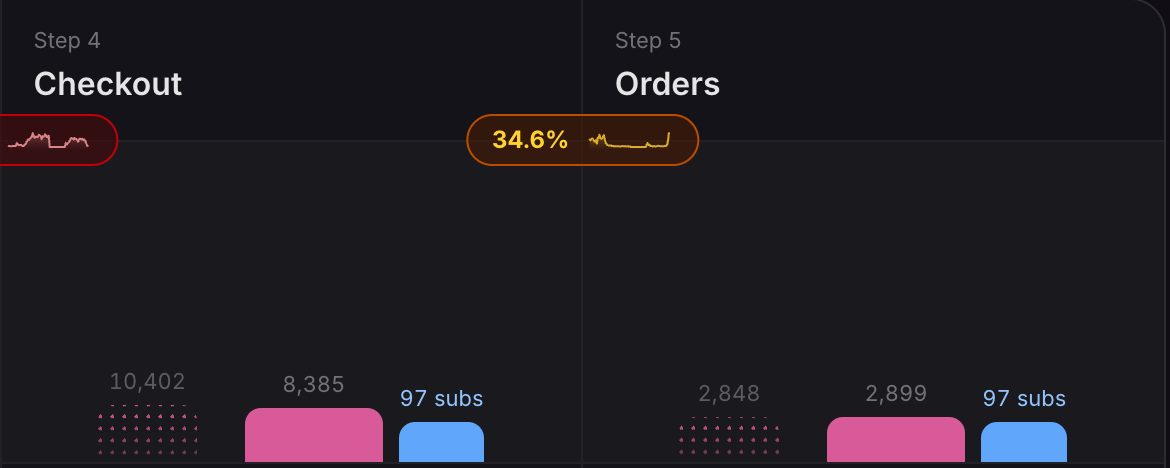
The Orders bar on the funnel has a lighter-blue segment for subscription reorders, on every plan. Without splitting, your conversion rate would include recurring renewals that never touched the funnel — inflating the apparent store-wide conversion.
Subscription Orders panel (Starter+)
Brand Pulse’s Subscription Orders panel reports your subscription orders on their own, separate from one-off orders.
Revenue numbers
- Total revenue includes everything.
- Attributed revenue (via UTM / channel) excludes recurring reorders because they have no session / no UTMs. Showing attribution on them would be a lie — your subscription app renewed them, not your ad.
First-order revenue
“First-subscription-order” revenue IS attributed normally — the customer clicked through to subscribe, the pixel saw the session, UTMs are present.
Why this matters for ROAS
A Meta campaign that drove 100 orders last month, where 40 of those orders were subscription reorders:
- Without subscription-aware attribution: ROAS looks great. But if Meta didn’t drive those reorders (your subscription app did), you’re over-crediting Meta.
- With subscription-aware attribution: the 40 reorders are excluded from Meta’s attributed revenue. ROAS is lower but closer to the truth of what Meta actually drove.
This matters most for subscription-heavy brands — coffee, supplements, beauty consumables. If <10% of your orders are subscription, the effect is small.
ROAS is calculated on net revenue — refunds are subtracted from their original-period revenue across both first-time and recurring subscription orders. A $50 first-subscription order with $25 of it later returned contributes $25 to its attributed channel. Refunds count the way Shopify’s Sales report counts them: returned items, refunded tax, shipping and duties. A goodwill cash refund with nothing returned isn’t a return in Shopify’s report and doesn’t reduce revenue here.
Which subscription apps are covered?
Any app that sells subscriptions through Shopify selling plans — including Recharge, Shopify Subscriptions, Loop, Skio, Smartrr and Ordergroove.
By plan
- Every plan — recurring reorders are left out of attributed revenue, and the funnel shows them as their own segment.
- Starter and higher — the Subscription Orders panel on Brand Pulse.